It’s 94 degrees, the air feels like a wet towel, and the vents are blowing lukewarm air. If you need AC repair in Jacksonville, NC, you’re in good company. Our long, humid summers push residential systems harder than almost anywhere in the state, and a unit that limped along in May can quit outright by July.
This guide walks you through what you can safely check yourself, what usually goes wrong in coastal humidity, what techs typically charge, and when replacing beats repairing. If you’d rather skip the guesswork, you can request AC repair help from a vetted local pro using the form on this page.
Quick answer: If your AC runs but doesn’t cool, check the thermostat, replace a dirty filter, make sure the outdoor unit isn’t blocked, and look for ice on the indoor lines or water around the air handler. Those fixes cover a lot of calls. If the problem is refrigerant, a failed capacitor, a frozen coil that returns after thawing, or a compressor issue, you need a licensed technician. Typical repairs run from under a couple hundred dollars to over a thousand, and a system past 12 to 15 years old with a major failure is usually a replacement conversation.
Key takeaways
- Start with the free checks: thermostat, filter, breaker, and clear space around the outdoor unit.
- Ice on the coil or a water-stained ceiling usually points to airflow or condensate drain trouble, which is common in humid coastal air.
- Low refrigerant means a leak. Topping it off without finding the leak is a short-term fix at best.
- Repair costs are typical ranges, not quotes. Always get an itemized estimate before work starts.
- If the system is old, uses outdated refrigerant, and needs an expensive part, compare repair against replacement.
Why AC Systems Struggle in Onslow County
Eastern North Carolina summers are as much about humidity as heat. Your AC isn’t just cooling air, it’s pulling gallons of moisture out of it every day. That means more condensation, more drain line work, and more runtime than a dry climate would demand.
Add salt air if you’re closer to Sneads Ferry, Swansboro, or North Topsail Beach, and outdoor coils corrode faster. Pollen, pine debris, and dust from the area’s many construction projects clog filters and coils quickly too.
If you’re not sure whether your system is on its way out, our guide to signs your AC is failing in eastern North Carolina’s humid summers covers the warning signs to watch for before a full breakdown.

Troubleshooting Checklist: What to Check Before You Call
Work through these in order. Turn the system off at the thermostat before touching anything, and never open electrical panels or handle refrigerant lines yourself.
1. Thermostat settings
Confirm it’s set to Cool, the setpoint is below the room temperature, and the batteries are fresh if it uses them. A fan set to On instead of Auto can also make the air feel warm and clammy between cycles.
2. Air filter
A clogged filter chokes airflow, which can freeze the evaporator coil and make the whole system work harder. Check it monthly in summer. If you can’t see light through it, replace it.
3. Breakers and the disconnect
Check the breaker for both the indoor and outdoor units, plus the outdoor disconnect box. A tripped breaker that trips again right after you reset it is a sign to stop and call a pro, not keep resetting.
4. Outdoor unit
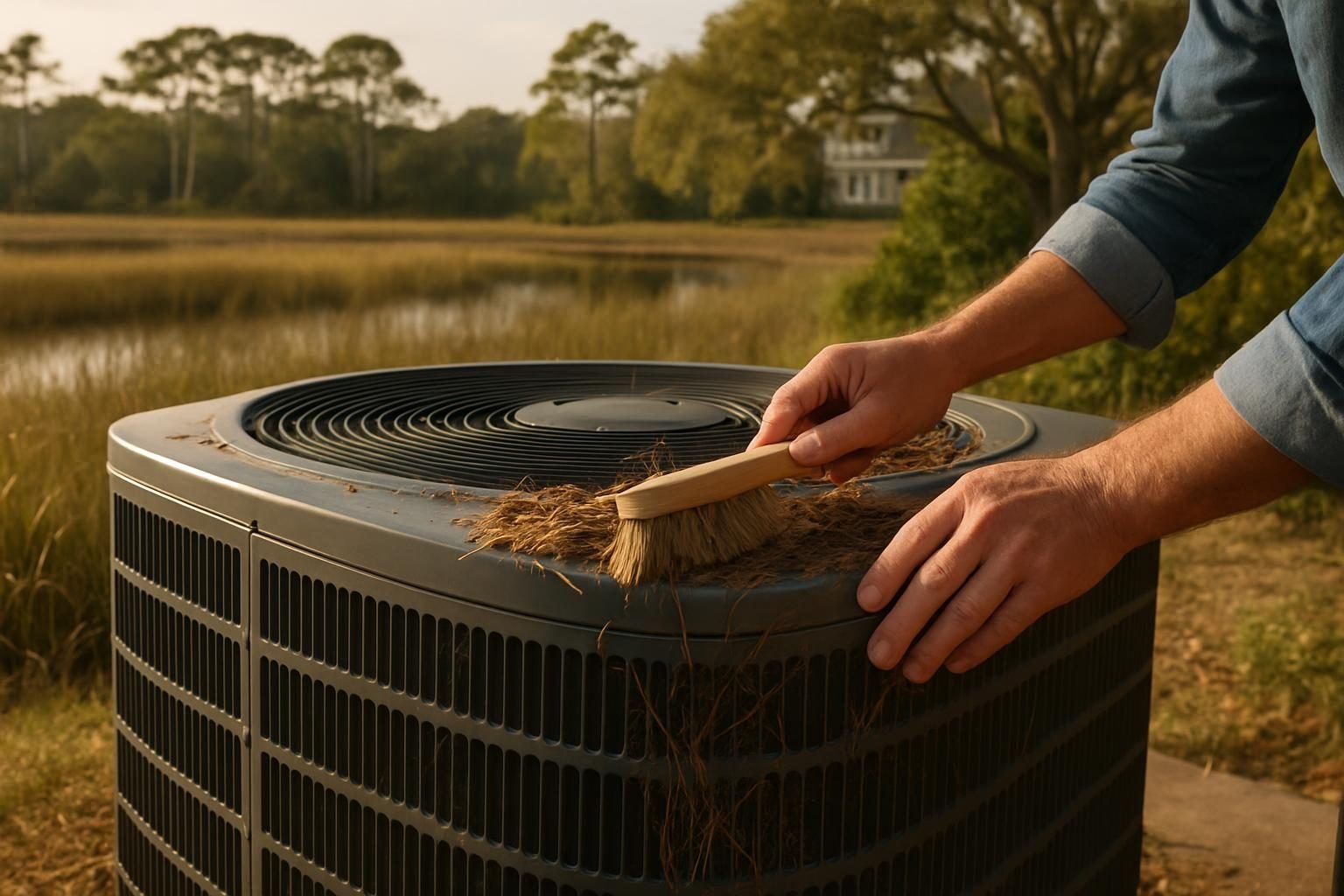
Look for grass clippings, leaves, pine straw, or shrubs crowding the condenser. Keep roughly two feet of clearance around it. Gently rinse the fins with a garden hose (power off first), spraying from the outside in.
5. Ice or frost on the lines or coil
Ice means airflow or refrigerant trouble. Switch the system off, run just the fan to help it thaw, and expect water. If ice returns after a clean filter, the cause is likely low refrigerant or a failing blower, which needs a tech.
6. Water around the indoor unit
Standing water near the air handler, or a drip pan that’s full, signals a clogged condensate line. In our humidity, algae and sludge build up in that line often.
In coastal humidity, a clogged condensate line is one of the most common and most preventable AC failures.
The Most Common Causes of an AC Not Cooling
Dirty or frozen evaporator coil
Dust that gets past the filter coats the indoor coil, insulating it and reducing heat transfer. The coil then ices over, airflow drops, and the system blows weak, warm air. Cleaning a coil is a pro job and often the fix for repeat freeze-ups.
Clogged condensate drain line
The line carries moisture from the coil to the outdoors. When it backs up, water overflows the pan, and many systems have a float switch that shuts the AC off to prevent damage. A slow-draining line left alone can stain ceilings and feed mold, so see our guide on mold remediation in Jacksonville, NC if you notice musty odors or discoloration.
Low refrigerant
Refrigerant isn’t consumed like gas in a car. If levels are low, there’s a leak. A tech should locate and repair it, then recharge. Be wary of anyone who only tops off the system repeatedly without leak-testing.
Failed capacitor or contactor
These electrical parts help the compressor and fans start. Heat and age wear them out, and a bad one often shows up as a humming outdoor unit that won’t spin. They’re among the cheaper repairs but not DIY-safe, since capacitors hold a charge.
Dirty condenser coil
Outdoor coils clogged with pollen, cottonwood fluff, or salt residue can’t shed heat, which raises pressures and can shorten compressor life.
Compressor or blower motor failure
The compressor is the heart of the system. A failure here is the repair most likely to tip you toward replacement, especially on an older unit.
Local tip: Pour a cup of a water and white vinegar mix (check your manufacturer’s guidance) into the condensate line access every month or two during summer to help keep algae from building up. It’s cheap insurance in our humidity.
What AC Repairs Typically Cost in the Jacksonville Area
Prices vary by company, system, parts availability, and time of day, and summer demand can stretch wait times. The figures below are rough typical ranges for the region, not quotes. Always ask for a written, itemized estimate.
| Repair | Typical range (estimate) | Notes |
|---|---|---|
| Diagnostic / service call | Roughly $75 to $200 | Often credited toward repair if you proceed; ask first |
| Condensate line clearing | Roughly $100 to $250 | Cheaper if caught before water damage |
| Capacitor replacement | Roughly $150 to $450 | Common summer failure |
| Contactor or relay | Roughly $150 to $400 | Often quick fix |
| Evaporator or condenser coil cleaning | Roughly $150 to $500 | Varies with access and condition |
| Refrigerant leak repair and recharge | Roughly $200 to $1,500+ | Depends on leak location and refrigerant type |
| Blower motor replacement | Roughly $400 to $1,200 | Depends on motor type |
| Compressor replacement | Roughly $1,500 to $3,500+ | Often approaches replacement cost |
Refrigerant type matters. Older systems use R-22, which has been phased out and is expensive and scarce, while newer systems use different refrigerants. Ask your tech which one your unit takes before approving a recharge.
A cheap service call is only a bargain if the estimate is itemized and approved before any work begins.
Repair or Replace? How to Decide
Most central AC systems last roughly 12 to 15 years, and coastal conditions can shorten that. A useful rule of thumb many contractors use: if a repair costs more than about half the price of a new system, or the unit is past its expected life, replacement usually makes more sense.
- Repair makes sense when: the system is under about 10 years old, the fix is a single inexpensive part, and it has been running well otherwise.
- Consider replacement when: the compressor fails, the system uses R-22, repairs keep recurring, or your electric bills have crept up for no clear reason.
- Also factor in: comfort problems like humid, clammy rooms, which can mean the system is oversized or worn out.
If you’re leaning toward a new system, our AC installation cost guide for Jacksonville, NC breaks down typical new-system pricing. If your home has a damp crawl space driving humidity and strain on the equipment, crawl space encapsulation can be worth a look alongside any HVAC decision.
Hiring an HVAC Pro in Jacksonville
Whether you’ve lived here for years or just PCS’d into Camp Lejeune housing or a rental off-base, the hiring basics are the same. Verify the company holds a current North Carolina HVAC license through the state licensing board, and ask for proof of insurance.
- Get at least two written estimates for anything beyond a basic repair.
- Ask for the diagnosis in plain language: what failed, why, and what the part costs.
- Confirm warranty terms on both parts and labor.
- Be cautious of anyone demanding full payment up front or pushing a replacement without testing the system.
- Ask whether they service your brand and system type.
If you live on base, check with your housing office or maintenance request process first, since base housing repairs typically go through official channels rather than private contractors. Our Camp Lejeune base housing guide explains the neighborhoods, and you should rely on official Camp Lejeune housing resources for current maintenance procedures.
Outside Jacksonville, we cover nearby options in our HVAC services guide for Sneads Ferry, and our upcoming HVAC service guide for Richlands will cover that side of the county.
Prepare Your AC for Storm Season
Hurricane season overlaps peak cooling season, and power surges and outages can damage compressors. Consider a surge protector for your outdoor unit and know how to shut the system off before a storm. After flooding or a long outage, have a tech inspect the system before restarting it.
Our hurricane preparation checklist for Onslow County homeowners covers the bigger picture, and a whole-house generator is worth considering if you want cooling during extended outages. Sizing matters, so talk to a qualified installer.
Still sweating? Request a quote from a vetted local HVAC pro and get your system looked at before the next heat wave.
AC Repair in Jacksonville, NC: FAQ
Why is my AC running but not cooling?
The most common causes are a dirty filter, a frozen evaporator coil, a dirty outdoor coil, low refrigerant, or a failed capacitor. Check the filter and thermostat first, then call a pro if the problem continues.
How much does AC repair cost in Jacksonville, NC?
Typical ranges run from roughly $75 to $200 for a diagnostic, a few hundred dollars for common parts like capacitors, and well over $1,000 for compressor work. These are estimates, so get itemized written quotes.
Why does my AC freeze up in humid weather?
Restricted airflow from a dirty filter or coil, or low refrigerant, can let the evaporator coil drop below freezing and ice over. Turn the system off to thaw it and have a tech investigate if it recurs.
Is it worth repairing a 15-year-old AC?
Usually not for a major repair. Systems that old are near the end of their typical life and may use phased-out refrigerant. If the repair costs more than about half a new system, replacement is often smarter.
Can I recharge my AC refrigerant myself?
No. Handling refrigerant requires certification, and low levels mean there’s a leak that needs repair. A proper fix involves finding the leak, not just adding more refrigerant.
Get free AC repair quotes from Jacksonville pros
Tell us what your system is doing and a vetted local HVAC pro will follow up with next steps and an estimate.