It is 11 p.m., there is water running down a wall, and you are wondering whether this can wait until morning. If you need an emergency plumber in Jacksonville, NC, the first ten minutes matter more than the first phone call. Shutting off the water and knowing what to tell the plumber can save you real money and real damage.
This guide covers what counts as a true plumbing emergency, how to stop the water, what after-hours service typically costs, and how to avoid getting burned when you are stressed and in a hurry.
If you would rather have someone start lining up help while you deal with the mess, you can request help from a vetted local plumber using the form on this page.
Quick answer: when to call an emergency plumber
Call an emergency plumber right away if water is flowing and you cannot stop it, if sewage is backing up into the house, if you smell gas, or if you have no water at all. After shutting off the water, a slow drip, a running toilet or a single clogged sink can almost always wait for regular business hours. In Jacksonville and the rest of Onslow County, expect after-hours calls to cost noticeably more than a daytime visit, so it pays to triage first.
Key takeaways
- Shut off the water first; most plumbing emergencies become non-emergencies once the flow stops.
- Gas smell, sewage backup and uncontrolled flooding are the calls that justify after-hours rates.
- Emergency rates are usually a multiple of daytime pricing, so ask about the trip fee and hourly rate before they roll.
- Document damage with photos before cleanup for your insurance claim.
- Locate your main shut-off valve now, before you ever need it.
What counts as a plumbing emergency
Not every plumbing problem is a middle-of-the-night problem. Here is a practical way to sort them.
Call now
- A burst or leaking pipe you cannot isolate with a valve
- Sewage backing up through floor drains, tubs or toilets
- A water heater that is leaking heavily, making loud banging or rumbling noises, or has a relief valve discharging
- No water at all to the house when the neighbors still have it
- Any gas odor near a gas water heater or furnace. Leave the house and call the gas utility or 911 first, then a plumber.
Can usually wait until morning
- A dripping faucet or a toilet that runs
- A single slow or clogged sink, tub or toilet while you have another working toilet
- A small leak under a sink where you can close the supply valve and set a bucket
- Low water pressure with no visible water
- A water heater that is lukewarm but not leaking
If you are unsure, shut the water off to the affected fixture or the whole house, and call a plumber’s after-hours line to describe what you see. A reputable company will tell you honestly whether it needs to be tonight.
Most plumbing emergencies stop being emergencies the moment you find the shut-off valve.
First steps: shut off the water and limit the damage
What you do before the plumber arrives often decides whether you have a repair bill or a restoration project. Work through these in order.
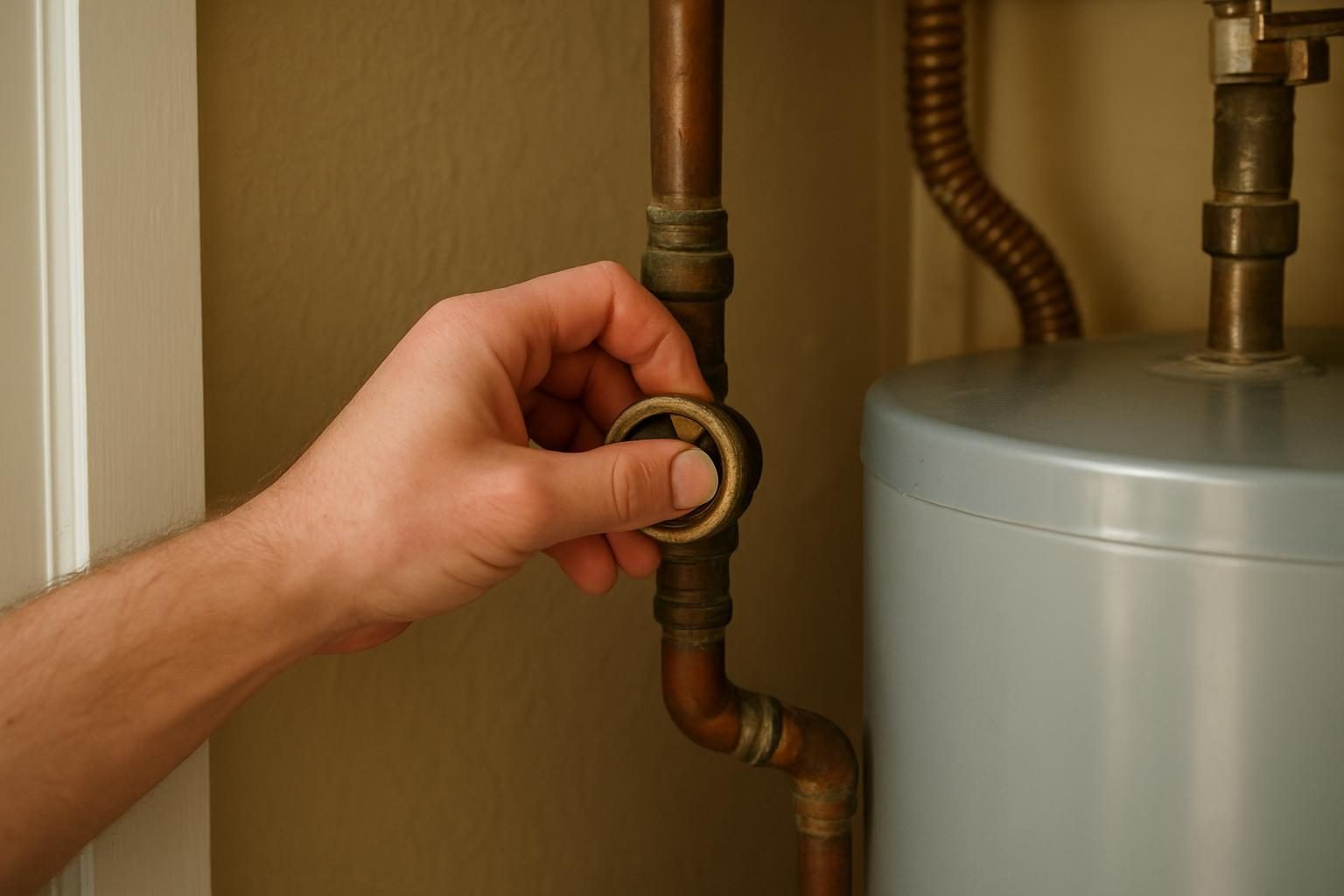
- Stop the water. Close the fixture shut-off valve if the leak is at a sink or toilet. If you cannot find it or the leak is in a wall or ceiling, close the main shut-off.
- Cut power if water is near electrical. If water is reaching outlets, appliances or the panel, turn off the affected breakers only if you can do so safely while standing in a dry spot. If not, call the power company or an electrician.
- Relieve the pressure. Open a faucet at the lowest point of the house to drain remaining water from the lines.
- Turn off the water heater. If the leak involves the water heater or you have lost water supply, switch off the electric breaker or set a gas unit to pilot or off so it does not run dry.
- Move belongings and soak up water. Pull rugs, electronics and furniture away, and use towels, mops or a wet vac on standing water.
- Take photos and video. Capture the source, the water and the damage before you clean up. Your insurer will want it.
Finding your main shut-off valve
In many Onslow County homes the main valve sits where the water line enters the house, often near the water heater, in a utility closet, in the garage or at an exterior wall. Homes on crawl spaces, common across Jacksonville and the surrounding towns, may have it under the house or at a meter box near the street. Look for a round wheel handle or a lever. A quarter-turn lever is parallel to the pipe when open and perpendicular when closed.
Test it once a year so it is not frozen when you need it. If it will not turn or does not stop the flow, that is a reason to call a plumber even before a leak happens.
Local tip: Take a photo of your shut-off valve and the water meter box and keep it in your phone. If you are renting or just PCS’d in, ask the landlord or property manager exactly where the main valve is before you unpack.
Common emergencies in Jacksonville and Onslow County homes
Burst or leaking pipes
Our winters are mild compared to the mountains, but we do get hard freezes, and an unprotected pipe in a crawl space can split during a cold snap. Aging supply lines, worn fittings and corroded pipes in older homes can also fail without any freeze at all. Salt air and humidity near the coast speed up corrosion on exposed metal components.
Sewer and drain backups
If more than one fixture is backing up, or water is coming up from a floor drain or the lowest tub, the blockage is likely in the main line. Roots, grease and flushed wipes are the usual culprits. Heavy rain can make it worse in areas where the ground is saturated. Stop using water in the house until it is cleared.
Water heater failures
Water heaters tend to fail when they are old, and the first sign is often a puddle or rust-colored water. A tank that is actively leaking should be shut off at the cold water inlet and its power or gas turned off. Banging noises or a relief valve that keeps discharging mean you should not wait. Water heaters in garages and closets are common here, so check the floor around yours.
Supply line and appliance failures
Washing machine hoses, toilet supply lines and ice-maker lines are small parts that cause big losses. Braided stainless hoses last longer than basic rubber ones, and replacing them every few years is cheap insurance. If you are away from the house often, consider turning off the washing machine valves when you leave.
A fifteen-dollar hose that fails while you are at work can cost thousands. Replace old washing machine and toilet lines.
What an emergency plumber costs in Jacksonville, NC
Prices vary by company, time of day and the work involved, and I will not quote you a single number as if it were a rule. What I can tell you is how emergency pricing is typically structured and what to ask. For a deeper breakdown of everyday rates, watch for our upcoming guide to how much a plumber costs in Jacksonville.
| Cost element | What to expect (typical, varies by company) |
|---|---|
| Trip or dispatch fee | Often charged for after-hours, weekend and holiday calls; some companies waive it if you book the repair |
| Hourly labor | Commonly higher than daytime, sometimes by a wide margin on nights and holidays |
| Flat-rate repairs | Many shops quote a fixed price per job once they diagnose it, which can be easier to compare |
| Parts and materials | Priced separately or built into the flat rate; ask which |
| Drain clearing or camera inspection | Usually quoted as a separate line item |
| Water heater replacement | A larger job; get a written estimate covering the unit, installation and haul-away |
As a rough frame of reference, a simple emergency visit can run from the low hundreds of dollars, while pipe replacement, main line repair or a water heater swap can climb into the thousands. Treat those as ballpark ranges, not quotes, and always get the price in writing before work starts.
Questions to ask before they roll
- Is there a trip fee, and does it apply toward the repair?
- Is the repair priced hourly or flat-rate, and when will I get the number?
- Are you licensed in North Carolina, and are you insured?
- What is your realistic arrival window?
- Do you offer a warranty on labor and parts?
How to hire a trustworthy emergency plumber
Panic is when people overpay. A few habits protect you.
- Check licensing. North Carolina licenses plumbing contractors. Ask for the license number and verify it with the state licensing board.
- Prefer local, established companies. A business with a real local presence and a history in the area is easier to hold accountable than a lead-generation call center posing as one.
- Be wary of the first search result. Ads at the top of search can be national dispatchers who subcontract the job. Ask who will actually show up.
- Get the price before the work. A legitimate plumber will give you an estimate or flat rate after diagnosing the problem.
- Do not sign a blank authorization. Read anything you sign, especially if it mentions financing.
- Save the paperwork. Keep invoices and any warranty documents for your records and your insurer.
If you are weighing a repair against a bigger project, such as replacing old supply lines throughout the house, get more than one opinion once the emergency is handled. That is a decision you can make at daytime pricing.
After the repair: water damage and insurance
Stopping the leak is step one. Wet drywall, insulation and subfloor can grow mold within a couple of days in our humidity, so dry out quickly. Our guide to water damage restoration in Jacksonville walks through the steps, timeline and costs.
Whether your homeowners policy pays depends on the cause and your coverage. Sudden and accidental discharge is treated differently from long-term seepage, and flood from rising water is generally a separate policy. Read our upcoming explainer on whether homeowners insurance covers water damage in North Carolina, and call your insurer before you start major repairs.
If the leak came from a crawl space issue or has left lingering moisture underneath the house, see our coming guide on crawl space repair in Jacksonville.
Storms and hurricane season
Hurricane season brings its own plumbing risks: power outages that stop sump and well pumps, flooded crawl spaces, and sewer backups when the ground is saturated. Before a storm, know where your shut-off is, fill a few containers with water, and charge your phone. For larger damage, see our coming guides on storm damage repair in Jacksonville and whole-house generator installation.
Plumbers across Onslow County
Emergency coverage varies by town, and travel distance affects both arrival time and trip fees. If you are out toward Richlands, watch for our upcoming guide to plumbers in Richlands. Homeowners in Swansboro, Sneads Ferry, Hubert, Holly Ridge and North Topsail Beach should ask any company up front whether they serve their address and what the after-hours travel charge is.
Military families who just arrived should also know that on-base housing maintenance is handled differently from off-base homes. If you live in base housing, report plumbing emergencies through your housing office’s maintenance process rather than calling a private plumber. Our on-base vs off-base housing guide explains the difference, and the Camp Lejeune PCS guide covers settling in. Renters off base should contact the landlord first, since the lease usually spells out who authorizes repairs.
Other systems tend to fail at the same time as plumbing in a storm or a cold snap. If your heating or cooling is acting up too, see our guide to HVAC repair in Jacksonville. If a leak is coming through the ceiling from above, you may be dealing with the roof rather than a pipe; our guide to choosing a roofing contractor in Jacksonville can help. Budgeting for home repairs is part of the bigger picture in our cost of living in Jacksonville guide.
Ready to get help? Request a quote from a vetted local plumber using the form on this page and describe what is happening.
Emergency plumber FAQ
Is a clogged toilet a plumbing emergency?
Usually not, especially if you have a second toilet. Try a plunger first and stop flushing. It becomes urgent if it is overflowing, if several fixtures are backing up at once, or if sewage is coming up through a floor drain.
Do emergency plumbers cost more at night and on weekends?
Generally yes. Many companies charge a trip fee and a higher hourly or flat rate for after-hours, weekend and holiday calls. Ask for the pricing structure on the phone before you agree to the visit.
What should I do while I wait for the plumber?
Shut off the water at the fixture or main valve, turn off the water heater if needed, keep away from electrical hazards, soak up standing water and take photos of the damage for your insurance claim.
Will homeowners insurance pay for a burst pipe?
It can, depending on your policy and the cause. Sudden and accidental water damage is often covered, while gradual leaks and flooding from outside are often treated differently. Call your insurer and read your policy before starting major repairs.
How do I know if a plumber is licensed in North Carolina?
Ask for the license number and verify it with the state’s plumbing licensing board. A legitimate contractor will provide it readily and carry liability insurance.
Get emergency plumbing help from Jacksonville, NC pros
Tell us what is happening and a vetted local plumber will follow up to discuss availability and pricing.